
"Doctor, Is Spine Surgery Safe?"
This is universally the first and most emotional question patients ask after being advised spine surgery. For decades, traditional open back surgeries were associated with fears of prolonged bed rest, immense postoperative pain, and worries about paralysis.
However, over the last 15 years, spine surgery has undergone a revolutionary technological transformation. Today, high-precision surgical tools, intraoperative 3D navigation, real-time neuromonitoring, and keyhole endoscopes have made spine procedures safer, more predictable, and remarkably less invasive.
5 Technological Breakthroughs That Transformed Spine Surgery:
1. High-Resolution 3D MRI & CT Imaging
Accurate preoperative planning maps the exact trajectory, size of the herniated disc fragment, and millimeter-level anatomy of neural structures.
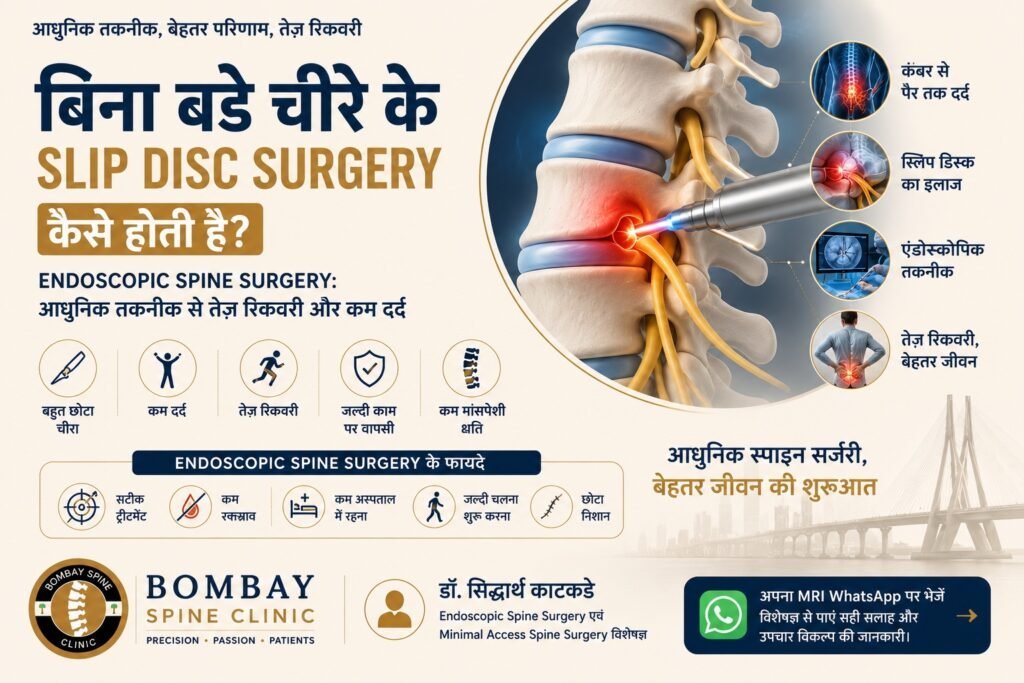
2. Full-Endoscopic Spine Surgery (ESS)
Using an ultra-thin 7mm camera tube under continuous fluid irrigation, surgeons directly visualize the compressed nerve and remove only the offending disc fragment without stripping back muscles.
3. Intraoperative Neuromonitoring (IONM)
Real-time neurophysiological monitoring tracks sensory and motor nerve signals continuously throughout the surgery, alerting the surgeon instantly and practically eliminating the risk of nerve injury.
4. 3D O-Arm & CT-Guided Navigation
Provides GPS-like precision for inserting spinal implants or resecting complex lesions, ensuring sub-millimeter accuracy.
5. Safer Anesthesia & Day-Care Protocols
Modern short-acting anesthetic agents and local anesthesia techniques allow patients to awaken smoothly, walk within 2-4 hours, and return home either the same day or next morning.
The Bottom Line
When performed by a fellowship-trained spine surgeon using modern minimally invasive protocols, spine surgery is a safe, routine, and highly successful procedure that restores quality of life.