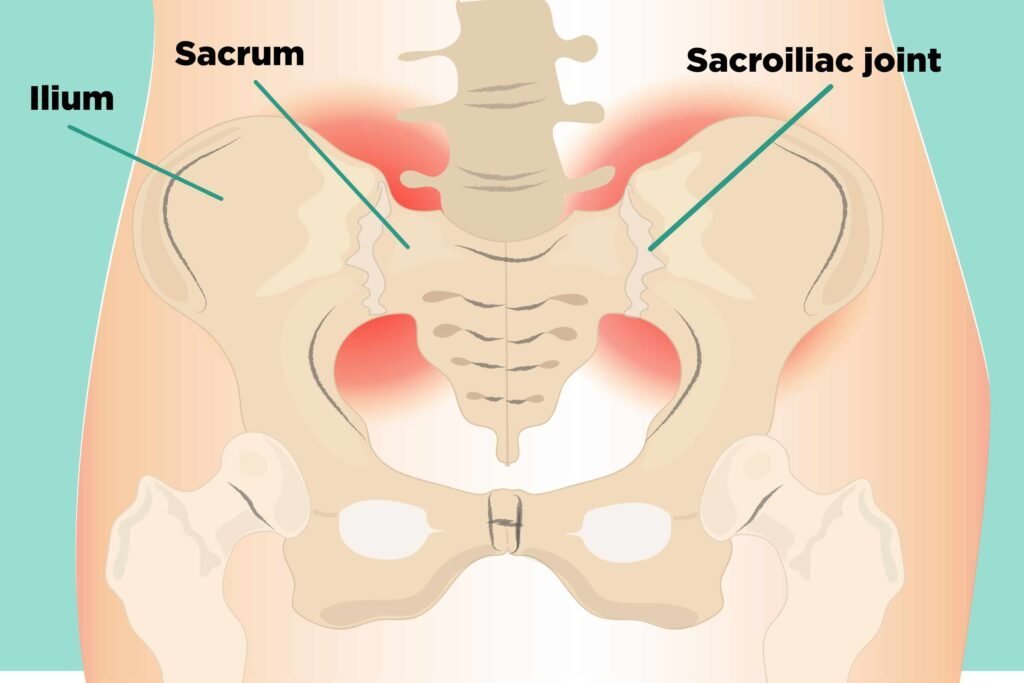
Sacroiliitis refers to inflammation of one or both sacroiliac (SI) joints, which connect the lower spine (sacrum) to the pelvis. These joints play an important role in transferring body weight between the spine and lower limbs.
Inflammation of the sacroiliac joints can cause pain in the lower back, buttocks and hips, often mimicking a slip disc or sciatica. Sacroiliitis may occur as an isolated condition or as part of inflammatory disorders such as Ankylosing Spondylitis.
Accurate diagnosis is important because treatment differs significantly from that of mechanical back pain.
Common Symptoms
Patients may experience:
Pain Symptoms
Pain in the lower back
Pain in one or both buttocks
Hip region pain
Pain radiating to the groin
Pain radiating to the upper thigh
Characteristic Features
Pain while standing for prolonged periods
Pain when climbing stairs
Pain while getting up from a chair
Morning stiffness
Pain that worsens after prolonged sitting
Difficulty turning in bed
Inflammatory Symptoms
In some patients:
Pain improves with activity
Pain worsens with rest
Night pain
Prolonged morning stiffness
Causes & Risk Factors
Inflammatory Disorders
The most common inflammatory causes include:
Ankylosing Spondylitis
Axial Spondyloarthritis
Psoriatic Arthritis
Reactive Arthritis
Degenerative Changes
Age-related wear and tear of the SI joints may cause pain and inflammation.
Pregnancy
Hormonal changes and increased stress on the pelvis may contribute to sacroiliac joint dysfunction.
Trauma
Falls, accidents or repetitive stress may affect the SI joints.
Infection
Rarely, infections may involve the sacroiliac joint.
Risk factors include:
Family history of inflammatory arthritis
HLA-B27 positivity
Previous pelvic trauma
Pregnancy
Autoimmune diseases
When Should You Seek Medical Advice?
Medical evaluation is recommended if:
Persistent buttock pain develops
Lower back pain does not improve with routine treatment
Morning stiffness lasts longer than 30 minutes
Pain wakes you from sleep
Symptoms improve with exercise but worsen with rest
Pain affects daily activities
Seek Prompt Medical Attention If:
Fever accompanies back pain
Severe pain develops suddenly
Progressive weakness occurs
Walking becomes difficult
Significant neurological symptoms develop
How Is It Diagnosed?
Clinical Examination
A detailed examination includes:
Assessment of sacroiliac joint tenderness
Provocative SI joint tests
Evaluation of spinal mobility
Assessment for inflammatory disease
X-Ray
May demonstrate:
Sacroiliac joint narrowing
Joint irregularity
Erosions
Fusion in advanced disease
MRI
MRI is often the most useful investigation.
It can detect:
Early inflammation
Bone marrow edema
Active sacroiliitis
Associated spinal inflammation
MRI is particularly valuable in early Ankylosing Spondylitis.
CT Scan
May provide detailed assessment of joint structure and chronic changes.
Blood Tests
May include:
ESR
CRP
HLA-B27
Infection markers
These tests help identify inflammatory and infectious causes.
Treatment Options
Non-Surgical Treatment
Treatment depends on the underlying cause.
Management may include:
Physiotherapy
Stretching exercises
Core strengthening
Postural training
Activity modification
Anti-inflammatory medications
Disease-modifying medications
Biologic therapies (in selected inflammatory conditions)
Treatment of the underlying disease is often essential for long-term symptom control.
Surgical Treatment
Surgery is rarely required.
It may be considered when:
Severe chronic pain persists
Significant joint dysfunction occurs
Conservative treatment fails
Selected patients may be candidates for:
Sacroiliac Joint Fusion
This is typically reserved for carefully selected cases.
Frequently Asked Questions
1. What is Sacroiliitis?
Sacroiliitis is inflammation of the sacroiliac joints that connect the spine to the pelvis.
2. Can Sacroiliitis cause buttock pain?
Yes. Buttock pain is one of the most common symptoms.
3. Is Sacroiliitis the same as Sciatica?
No. Although symptoms may overlap, the underlying causes are different.
4. Can Sacroiliitis cause hip pain?
Yes. Many patients experience pain around the buttock, hip and groin region.
5. Is Sacroiliitis related to Ankylosing Spondylitis?
Yes. Sacroiliitis is often one of the earliest manifestations of Ankylosing Spondylitis.
6. Is MRI necessary?
MRI is often extremely useful because it can detect inflammation before changes appear on X-rays.
7. Can physiotherapy help?
Yes. Physiotherapy is an important component of treatment.
8. Does every patient need surgery?
No. Most patients improve with non-surgical treatment.
9. Can pregnancy cause Sacroiliac Joint pain?
Yes. Pregnancy-related hormonal and biomechanical changes may affect the SI joints.
10. When should I suspect Sacroiliitis?
Persistent buttock pain, morning stiffness and pain that improves with exercise should raise suspicion.
Related Conditions
Ankylosing Spondylitis
Mechanical Low Back Pain (Lumbago)
Sciatica
Spondylolisthesis
Osteoporosis
Spinal Infection
When Should You Consult a Spine Specialist?
If you experience persistent buttock pain, inflammatory back pain, prolonged morning stiffness or symptoms suggestive of sacroiliac joint disease, early evaluation is recommended.
Timely diagnosis can help identify underlying inflammatory conditions and guide appropriate treatment before long-term joint damage occurs.
Need Expert Advice?
Book a consultation with Dr. Siddharth Katkade or upload your MRI, X-rays or reports for review through our Patient Resource Centre.
Need Clinical Evaluation?
Consult with Dr. Siddharth Katkade (MBBS, MS, DNB, FASSI Germany/UK) for accurate diagnosis and personalized spine treatment.