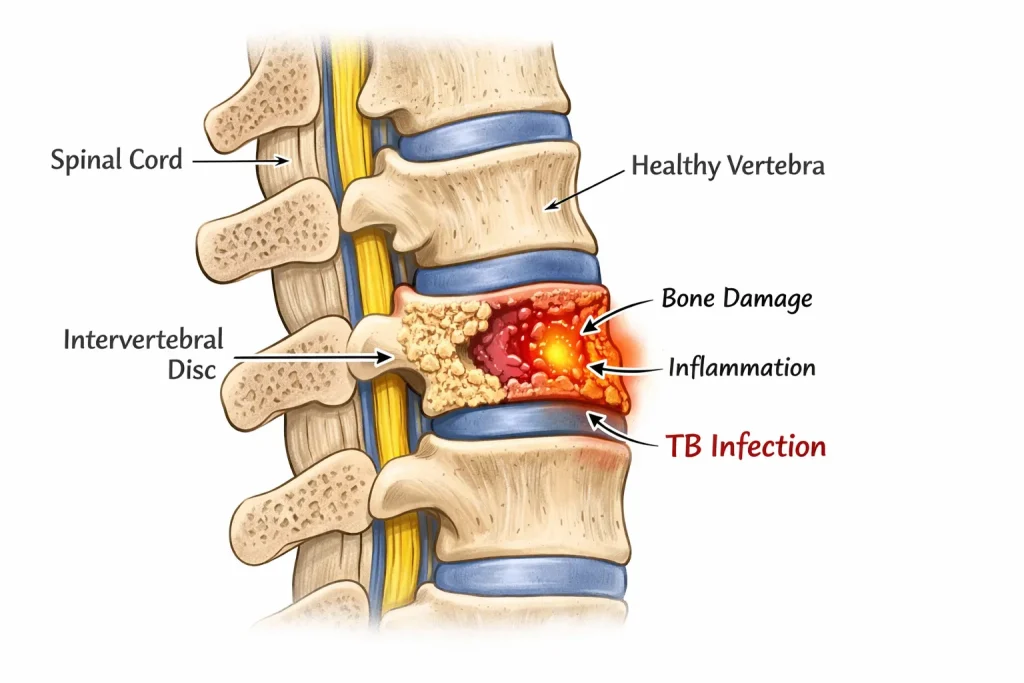
Surgery for Spinal Tuberculosis with Nerve Compression, Spinal Instability & Spinal Deformity
What Is This Surgery?
Spinal Tuberculosis (TB Spine) Surgery is performed to treat tuberculosis affecting the spine, particularly when the infection causes pressure on the spinal cord or nerves, spinal instability, severe pain or progressive spinal deformity.
Although most patients with spinal tuberculosis can be successfully treated with Anti-Tubercular Therapy (ATT) alone, surgery becomes necessary in selected patients to remove infected tissue, decompress the spinal cord, stabilise the spine and restore spinal alignment.
The goals of the surgery are to:
Remove infected and damaged tissue
Relieve pressure on the spinal cord and nerves
Stabilise the spine using screws and rods when required
Correct or prevent progressive spinal deformity (Kyphosis)
Improve neurological recovery
Reduce pain
Allow early mobilisation
Improve long-term quality of life
Depending on the location and severity of the disease, surgery may be performed using Minimally Invasive Spine Surgery (MISS), Tubular Surgery, Endoscopic techniques or Conventional Open Surgery. The surgical approach is individualised for every patient.
Patients with neurological weakness or spinal instability often require early surgical intervention in addition to Anti-Tubercular Therapy.
Who Is A Suitable Candidate?
You may be a suitable candidate if:
✓ MRI shows spinal cord or nerve compression.
✓ Progressive neurological weakness develops.
✓ Significant spinal instability is present.
✓ Vertebral collapse causes spinal deformity.
✓ Large abscesses require surgical drainage.
✓ Severe pain persists despite medical treatment.
✓ Diagnosis requires tissue biopsy.
✓ Conservative treatment alone is unlikely to provide satisfactory recovery.
It is important to understand that the majority of patients with TB Spine do not require surgery and recover successfully with appropriate medications under close medical supervision.
How Is The Surgery Performed?
Step 1
The procedure is performed under general anesthesia. The surgical approach depends upon the location of the infection, the degree of spinal destruction and the patient's neurological status.
Step 2
The affected spinal level is identified using advanced intraoperative imaging.
Depending on the individual case, the surgery may be performed through a minimally invasive or open approach.
Step 3
The infected tissue, pus (abscess), dead bone and diseased disc material are carefully removed. Tissue samples are sent for microbiological and histopathological examination to confirm the diagnosis and guide antibiotic treatment.
Step 4
The spinal cord and nerve roots are carefully decompressed by removing the structures causing compression.
If significant vertebral destruction or instability is present, spinal stabilisation is performed using pedicle screws, rods and, when required, cages or bone grafts to restore stability and alignment.
Step 5
After confirming adequate decompression and stable fixation, the wound is thoroughly cleaned and closed in layers with appropriate drains if required.
The duration of surgery depends on the extent of infection, spinal levels involved and the complexity of reconstruction.
What Are The Advantages?
Potential benefits include:
Effective decompression of the spinal cord and nerves
Relief of severe pain
Improved neurological recovery
Restoration of spinal stability
Prevention of progressive deformity
Safe drainage of abscesses
Early mobilisation
Faster rehabilitation
Improved spinal alignment
Better quality of life
When combined with appropriate Anti-Tubercular Therapy, surgery significantly improves outcomes in carefully selected patients with complicated spinal tuberculosis.
What Are The Risks?
Every surgical procedure carries certain theoretical risks and potential complications. However, every effort is made to minimise these risks through meticulous surgical planning, advanced technology and comprehensive patient optimisation.
At Bombay Spine Clinic™, surgery for Spinal Tuberculosis is performed using modern spinal instrumentation, high-definition imaging, specialised decompression techniques and contemporary reconstructive principles. Whenever appropriate, minimally invasive techniques are utilised to minimise tissue damage and facilitate recovery.
Every patient undergoes a detailed pre-operative assessment involving physicians, infectious disease specialists, anaesthetists and other specialists whenever required. Anti-Tubercular Therapy is carefully coordinated before and after surgery to maximise treatment success.
Potential risks discussed with patients include:
Infection
Bleeding
Dural tear (CSF leak)
Nerve injury
Persistent neurological deficits
Implant-related complications
Failure of fusion
Persistent spinal deformity
Delayed wound healing
Recurrence or persistence of infection (rare)
Rare need for revision surgery
Fortunately, with modern surgical techniques, appropriate Anti-Tubercular Therapy and multidisciplinary care, successful outcomes are achieved in the vast majority of appropriately selected patients.
Preparing For Surgery
Before surgery:
Detailed clinical evaluation
MRI review
CT scan review
Standing X-rays (if required)
Blood investigations
ESR and CRP levels
Medical fitness assessment
Anaesthesia assessment
Review of Anti-Tubercular Therapy
Patients should inform their doctor regarding:
Diabetes
Heart disease
Previous spinal surgeries
Allergies
Previous TB treatment
Other medical illnesses
Optimising nutrition and correcting anaemia before surgery significantly improve recovery.
What Happens During Hospital Stay?
Day of Surgery
Hospital admission
Surgery
Recovery room observation
Pain management
Neurological monitoring
First 24–72 Hours
Assisted walking (when appropriate)
Physiotherapy guidance
Respiratory exercises
Wound care
Nutritional support
Continuation of Anti-Tubercular Therapy
Discharge
Most patients are discharged within:
4–7 days
depending on the complexity of surgery and neurological recovery.
Recovery After Surgery
Week 1
Expected symptoms:
Mild wound discomfort
Gradual improvement in pain
Walking encouraged under supervision
Continuation of Anti-Tubercular Therapy
Weeks 2–6
Progressive walking programme
Physiotherapy
Improvement in strength and endurance
Follow-up consultation
6 Weeks–3 Months
Continued rehabilitation
Improvement in neurological function
Return to light daily activities
Regular monitoring with blood tests and imaging
Long-Term Recovery
Recovery from spinal tuberculosis continues over several months. Anti-Tubercular Therapy is usually continued for 9–18 months, depending on the severity of infection and your treating physician's recommendations.
Most patients experience excellent improvement in pain, neurological function and quality of life when surgery is combined with appropriate medical treatment.
When Can I Return To Work?
Occupation
Approximate Timeline
Work From Home
3–4 weeks
Desk Job
6–8 weeks
Light Physical Work
8–12 weeks
Heavy Manual Labour
4–6 months
Driving
6 weeks
Sports & High-Impact Activities
4–6 months
Frequently Asked Questions
1. Why do I need this surgery?
Because spinal tuberculosis is causing pressure on your spinal cord or nerves, spinal instability, severe deformity or neurological weakness that cannot be adequately treated with medications alone.
2. Are there alternatives to surgery?
Yes. Most patients with spinal tuberculosis recover successfully with Anti-Tubercular Therapy alone. Surgery is recommended only when specific complications develop.
3. Will I have a large scar?
The size of the incision depends on the surgical approach. Whenever appropriate, minimally invasive techniques are used to reduce tissue damage and improve cosmetic outcomes.
4. How long will I stay in hospital?
Most patients remain in hospital for approximately 4–7 days, depending on the complexity of surgery.
5. When can I start walking?
Many patients begin assisted walking within 24–48 hours, depending on their neurological condition and overall recovery.
6. When can I climb stairs?
Most patients can climb stairs safely under supervision before discharge, if medically appropriate.
7. When can I drive?
Driving is generally permitted after approximately 6 weeks, depending on pain control, strength and your surgeon's advice.
8. When can I return to work?
Office-based work usually resumes within 6–8 weeks, while physically demanding occupations may require 4–6 months.
9. What is the success rate?
When combined with appropriate Anti-Tubercular Therapy, surgery for TB Spine has a high success rate in relieving pain, preserving neurological function, correcting spinal instability and improving quality of life. Early diagnosis and timely treatment are important factors influencing outcome.
10. Will I still need Anti-Tubercular medicines after surgery?
Yes. Surgery does not replace Anti-Tubercular Therapy. The operation treats the mechanical complications of spinal tuberculosis, while the medications eradicate the infection. Completing the full course of Anti-Tubercular Therapy is essential for complete recovery.
Myth vs Fact
Myth:
Every patient with TB Spine requires surgery.
Fact:
Most patients with spinal tuberculosis recover successfully with Anti-Tubercular Therapy alone. Surgery is reserved for selected patients with spinal instability, neurological deficits, large abscesses or progressive deformity.
Myth:
Once surgery is performed, TB medicines are no longer required.
Fact:
Surgery is only one part of treatment. Completing the prescribed course of Anti-Tubercular Therapy is essential to completely eliminate the infection and prevent recurrence.
When Should I Contact My Surgeon After Surgery?
Contact your surgeon if you experience:
Fever
Increasing wound discharge
Progressive weakness
Severe back pain
Difficulty walking
Difficulty passing urine
New numbness
Persistent weight loss or worsening general health
If you have been diagnosed with Spinal Tuberculosis, have persistent back pain despite Anti-Tubercular Therapy, or have been advised spine surgery, you may schedule a consultation or upload your MRI, CT scan and medical reports for specialist review.
Dr. Siddharth KatkadeConsultant Spine Surgeon
Bombay Spine Clinic™
Need Clinical Evaluation?
Consult with Dr. Siddharth Katkade (MBBS, MS, DNB, FASSI Germany/UK) for accurate diagnosis and personalized spine treatment.